
The Weekly Docket

Friends,
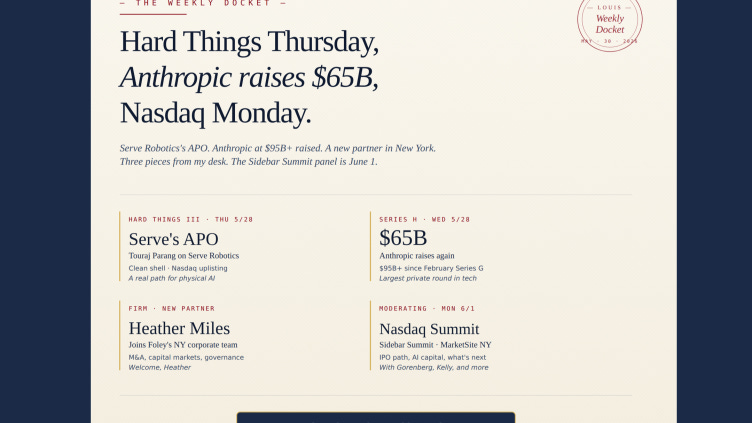
Big week. Hard Things Round Three on Thursday in San Francisco, a new client deal, a new partner joining us in New York, a piece from my desk, and the largest private financing in the history of technology dropped on Wednesday. On Monday I am at Nasdaq for the Sidebar Summit. Here is the docket.
Last Week (May 25 to 29)
Hard Things Round Three landed on Thursday in San Francisco, and Touraj Parang made it the night. Touraj walked the room through how Serve Robotics found its way to the public markets. Serve did not have the economics for a conventional IPO, and the team had no appetite for the fees and structural compromises of a de-SPAC. So they did something more interesting. They executed an Alternative Public Offering: a merger with a clean OTC shell, a Nasdaq uplisting, and a public offering, in that order. The point Touraj drove home is that Serve is not a five-year-old company. The technology, the team, and the conviction predate the spinout by a long stretch, and the business is now scaling across markets in the United States. The takeaway for the room was simple. The path from private to public is no longer one road. For physical AI companies whose unit economics do not fit the traditional IPO template, the APO is a real, credible alternative, and the cleanliness of the shell is everything. In the audience: the founders and investors building the next generation of physical AI companies, which is the entire reason we built this series.
Foley represented Preva Aesthetics in its partnership with Alpha Aesthetics Partners, a portfolio company of Thurston Group. Congratulations to Michelle Paty and the Preva team. Preva runs a preventative-aesthetics practice with locations in Denver and Encinitas, known for an injector-led philosophy and subtle, natural-looking results. The structural point worth flagging is what happens when a clinician-founded practice partners with a private-equity-backed platform. The deal lives or dies on the management services agreement and the equity rollover. Founders walk into these conversations focused on the headline number and walk out remembering what mattered was the governance, the non-competes, and the long-tail of how the clinical voice gets protected inside a financial sponsor’s model. The boring documents are never boring.
Foley expanded its New York corporate team with the addition of Heather Miles as partner. Heather joins us in the New York office from Goodwin Procter, where she advised both companies and investors on the legal and strategic issues that shape high-growth businesses. Her practice spans the sectors that matter most to our work: innovative technology, manufacturing, industrials, health care, and energy and infrastructure. She brings real depth representing venture capital funds, private equity firms, family offices, and institutional investors across transactions and fund formation. New York has been one of the busiest deal markets in the country for the last twelve months, and adding a partner of Heather’s caliber is exactly the kind of investment that lets us keep saying yes to the work our clients send us. Welcome to the firm, Heather.
Anthropic raised $65 billion in a Series H on Wednesday. That is not a typo. The round brings Anthropic’s total raised to north of $95 billion since its February Series G, with Altimeter, Dragoneer, Greenoaks, Sequoia, Capital Group, Coatue, D1, GIC, ICONIQ, XN, and strategic participation from Micron, Samsung, and SK hynix. Set aside the number for a moment and look at what it represents. We have crossed a threshold where the largest private financings now dwarf the largest public ones, where the strategic investor list reads like a memory and chip supply chain because the unit economics of a frontier model are inseparable from compute and the silicon that makes it. This is the moment to remember what I wrote last week about the SEC reforms: the rules that govern private markets at this scale need a rearchitecture, not a longer on-ramp. Reinstate the 500-holder registration trigger, and require companies that have raised this kind of capital to publish audited financials. A company that has taken $95 billion from the largest investors on the planet is not a startup. The disclosure regime should catch up.
The rest of the week’s tape mattered too. Mastercard agreed to acquire BVNK for up to $1.8B, NextEra bought Caliber Resource Partners for $1.3B, AIG announced a deal to acquire Everest’s insurance operations in Colombia, and earlier in the cycle Anthropic quietly tucked in Stainless to bolster developer tools. On the venture side, Stord closed a $250M Series F led by existing investors including Strike, Kleiner Perkins, Founders Fund, Franklin Templeton, Baillie Gifford, G Squared, Bond, and Lux, the kind of capital stack that tells you logistics and physical commerce are quietly becoming AI infrastructure. OpenRouter raised $113M Series B led by CapitalG, which is the most important signal in the venture tape. The winning pitch is no longer “we apply AI to X.” It is “we control the data, compliance trail, or operational choke point around X.” OpenRouter is selling the exchange layer between applications and the model providers, and CapitalG is paying up for the toll booth. Read that as a signal for where the next round of value capture is heading.
From My Desk
◊ Dexit, One Year Later: An Assessment of SB 21, the Continuing Pace of Reincorporation, and the Maturation of Texas as a Corporate Domicile. A one-year look at what SB 21 has done to the Texas-versus-Delaware question. The short version: Texas is no longer a contrarian choice, it is a serious alternative, and the reincorporation pace is real. If you are a board considering domicile, read it before the next governance review.
On the Calendar
◊ Sidebar Summit at Nasdaq. Monday, June 1, New York. I am moderating the 3:00pm panel. Forty-five minutes inside the Nasdaq MarketSite with an audience of about 100 to 125 investors, founders, and operators. No slides. No podium. No safety net. Less a panel than the conversation that usually happens at the dinner after the conference. Joining me are Mark Gorenberg (Zetta Venture Partners, Chairman of the MIT Corporation), Chris Kelly (investor across AI, blockchain, and infrastructure), and others. We will push on what is structurally broken about the IPO machine, where capital is being misallocated, which layer of the AI stack captures durable value, what comes after the LLM paradigm, whether the traditional IPO is still the destination or one option on a menu, and whether the geographic clustering of innovation is still holding. If you are in New York, register here and find me at the break.
◊ Secondaries Forum and Foley San Francisco Office Opening. Tuesday, June 9. Two events in one night. We are formally opening our new San Francisco office, and we are doing it with a Secondaries Forum that brings together the practitioners actually closing the deals: tender offers, GP-led secondaries, continuation vehicles, and structured liquidity programs. With the IPO window genuinely open but companies staying private longer than their investors ever planned, this is the liquidity conversation that matters. Come for the conversation, stay for the office opening, and meet the team in our new home. Register here.
◊ Foley at Boston Tech Week and NY Tech Week. Out in force at both. Reply if you want to find each other in the scrum.
Closing Argument
◊ If your AI company does not fit the conventional IPO mold, the APO is a real option. A merger with a clean OTC shell followed by a Nasdaq uplisting is how Serve Robotics did it. Study the structure before you commit to the wrong path.
◊ If you are a clinician-founded practice considering a PE partnership, the headline number is not the deal. The MSA, the equity rollover, the non-competes, and the protection of the clinical voice are where the value sits.
◊ If you are watching the Anthropic round and wondering what it means for the rest of the market, the disclosure regime for systemically large private companies is now genuinely broken. The fix is the 500-holder rule and forced financials at the $1B-raised threshold.
◊ If you are evaluating reincorporation, Texas has crossed from contrarian to credible. Read the Dexit piece and run the analysis on your specific facts.
◊ If you are in San Francisco on June 9, come to the Secondaries Forum and the opening of our new SF office. It will be a good night.
◊ If you are in New York on Monday, come to the Nasdaq Sidebar Summit. No slides, no filler, no mercy.
— Louis